

For small businesses, internet marketing is essential since it helps build their brand and boost sales. However, a lot of people waste resources by making typical mistakes that are usually simple to fix once they are recognized. Small businesses must be aware of these errors if they want to improve the efficacy of their internet marketing.
Not Understanding the Target Audience
Not knowing exactly who their target audience is is one of the biggest mistakes small businesses make when it comes to online marketing. In an attempt to increase sales, many entrepreneurs aim to market their goods and services to as many people as possible. In practice, this strategy typically has the opposite effect.
Your message becomes ambiguous when you don’t know who your target audience is. You have no idea what issues they are dealing with, what they truly need, or what language they can understand. Your advertisements, social media posts, and website content thus fall short of making a human connection with people.
People may view your stuff as a result, but they won’t be interested. They don’t think they are understood by your brand. Even if your product is fantastic, this results in low engagement, fewer clicks, and very bad conversions.
Small businesses should first take the time to understand their ideal client in order to prevent this error. This entails being aware of their location, age range, hobbies, purchasing patterns, and issues they wish to resolve. Content that seems relevant, helpful, and trustworthy is much easier to develop after you have a strong understanding of your audience.
The correct people will feel a connection to your business when your marketing message talks to them personally. This enhances engagement, fosters trust, and raises the likelihood that visitors will become actual clients.
Ignoring SEO (Search Engine Optimization)
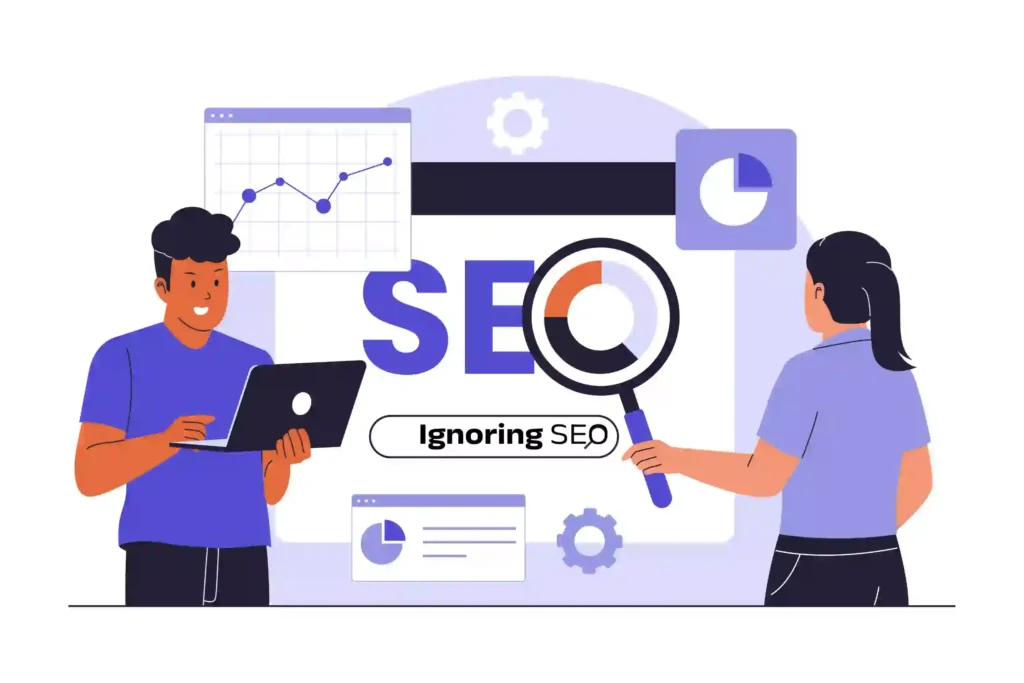
Because they believe SEO is too complicated, too technical, or only helpful for large corporations, many small firms disregard it. Some entrepreneurs think that simply having a website will suffice and that customers will find it on their own. In actuality, this is among the most significant errors in internet marketing.
Ignoring SEO prevents your website from showing up in Google search results, even when people are looking for the goods or services you provide. This implies that you are losing out on valuable visitors to your website that could have arrived for free. Rather, those visits and potential consumers end up in the hands of your rivals.
Your website’s content may seem fine without effective SEO, but it won’t help your business expand. Your intended audience cannot see your pages because search engines do not comprehend the purpose of your website.
Small firms should concentrate on fundamental SEO techniques to steer clear of this error. Using the appropriate keywords, creating informative and understandable content, optimising page titles and descriptions, and ensuring that the website loads quickly and functions properly on mobile devices are all part of this.
Shortcuts and techniques are not the point of SEO. It’s about making your company easier for search engines to comprehend and making it easier for users to locate the information they need. When done right, SEO helps small businesses expand gradually over time, generates long-term traffic, and fosters trust.
Poor Website Design and User Experience
The overall user experience and website design are neglected by many small enterprises. They concentrate on increasing the amount of material or promotions, but they neglect the initial feelings of users when they enter the website. This is a frequent yet dangerous error in internet marketing.
Visitors soon become disinterested in a website that appears antiquated, loads slowly, or is challenging to use. The majority of them depart from the website without doing anything because they are uncomfortable, confused, or frustrated. Even if the product or service is good, this still occurs.
Trust is also diminished by a bad user experience. A company’s website is frequently used to evaluate it. Users can assume that the company is not trustworthy or serious if the website does not appear professional or function correctly on mobile devices.
Small businesses should concentrate on maintaining a clear, concise, and user-friendly website in order to avoid making this error. Important information should be easily accessible, pages should load quickly, and the website should function flawlessly on desktop and mobile devices.
Beautiful effects are not the key to a well-designed website. Making guests feel at ease and facilitating their transition to the next phase are the main goals. Users are more likely to stay on your website longer, trust your business more, and become customers when they have a positive experience.